Monday, August 16, 2010

Gaining Confidence?

You might expect the leader of Canada's Green party to write little more than a book on how the government has failed on the issue of climate change. After all, the misconception that the Greens build their platform solely off one specific niche issue does persist today, as is evinced by dismal election results.

But in Losing Confidence: Power, Politics, and the Crisis in Canadian Democracy, Elizabeth May inadvertently quashes that assumption. Her book conveys considerable knowledge of the mechanics of the Canadian political system in drawing attention to the dangerous path Canada is headed down.

Although her message is hardly alarmist, she does spell out in concise and accessible prose a number of signs that the quality of our democracy is in sharp decline: the lack of respect among parliamentarians, the prevalence of blindly partisan attack ads, the shrinkage of Canadian media, declining political literacy and voter turnout, and others. At times, the opening and closing of each chapter reminds me of essay structure we learned back in grade twelve; in other words, May opens the odd chapter telling the reader something she already made crystal clear on the previous page. To her favour though, this structure does make it easy to read each chapter in isolation from the others. What this comes down to, as far as I'm concerned, is accessibility at the slight expense of style.

To May's credit though, her arguments about the decline of transparent democracy in favour of partisanship and buzz-language supersede stylistic concerns a bit. If Canadians have become the victims of the silver-tongued partisans, clarity is a priority first and foremost. She draws on the knowledge of politicians, officials, insiders, and columnists from all political persuasions to make a strong case for the crisis in democracy, one that holds in store praise and blame for members of all different federal parties.

I hope that, given the accessibility of this book, more people will read it, and, if not take Elizabeth May more seriously as a politician, at least become more aware of some of the issues at stake in democracy. The 40.1% of Canadians who did not vote in the previous election could have made a significant difference in the way in which government has been run for the past two years. Losing Confidence is on to something, and though its writer may never be prime minister, her message has the potential to open Canadians' eyes to the political world we live in.

Monday, August 9, 2010

Team Alcide: True Blood 3.8, "Night on the Sun"

At risk of giving something away here, I have to say that this episode began and ended with Sookie screaming. Overall, Sookie was very loud this episode. What we have here is an interesting turning point in her character development; she's louder and badder than ever before. As this third season continues to ratchet up the violence, with the many "stakings" and twisted sex scenes portrayed, our favourite characters change accordingly.

As I've made clear, the most obvious change in character can be seen in Sookie here. Although the series opened with her beating up the Rattrays with a chain (if you remember), that scene shies in comparison with her recent skirmishes with Lorena and Debbie. Consider: "You wouldn't know love if it kicked you in the FANGS!" and "GET OUT OF MY HOUSE, BITCH!"

Sookie is, of course, quickly becoming more and more aware of her own powers, and there can be little doubt that awareness is spurring her development into something bold and bad. Towards the end of the season, I think the person she's becoming will land her in some new conflicts and possibly force her to take a step back and look at what she's becoming.

Still, the ultimate ego boost is inevitable. Important people, like Russell, want her. As he says to Bill, "I'll trade you the red one for the blonde one."

Speaking of the red one, Jessica too is becoming quite a violent young lady, as Bill schools her in blurry vampire martial arts and trains her to sink her fangs into a few werewolves. At one point, she reflects that the person she's become will never deserve someone as good-natured as Hoyt.

"Who...?" seems to be the recurring theme these last few episodes. Who are the characters becoming?

Who is the British lady in Sookie's dream?

Who are the Norrises?

Who is Jesus, really, and who for that matter, is Lafayette?

Who will Arlene's baby turn out to be? Will her anxieties turn out to be a source of more comic relief, or is there something more sinister about the fact that Drew Marshall is the father?

The exception to these Why questions is Where did Alcide go, driving off in his contracting truck like that? Doubtless he'll be back, at least in time for the seasons's finale, but for those who see him as a potential alternative to Bill (who is bland) and Eric (who seems to find more at stake with his relationship with Talbot than Sookie...), that isn't soon enough.

Monday, July 26, 2010

Mark Zuckerberg, PR monstrosity

If you went to the movies this weekend to see either Salt or Inception, you would have seen this trailer.

It's for The Social Network, which is based on how a hoody-wearing average student who happened to attend Harvard founded Facebook.

Now, don't get me wrong--I like hoodies, especially zip hoodies. But when you're being questioned by privacy commissioners, government officials, and the media about how your software violates people's rights to privacy, when people are making public complaints about your company, when your reputation may very well be at stake, you might consider suiting up, so listeners and viewers start taking you a little more seriously.

Perhaps that's what this film will do. Perhaps after seeing The Social Network, due to be released on October 1st, people will feel sympathy for Mark, and appreciate all the equations written with window-writers, the all-nighters, the exclusivity of Ivy League school clubs, etc., etc.

But then again, Jesse Eisenberg is playing him, so probably not.

Truly, True Blood's bloodiest

Last night's episode of True Blood was probably the goriest and most sadistic to date. If Sookie's dependence on Bill had you scrambling for evidence that this show is any different from Twilight, you need only watch "What Do You Know About Love?" for reminder.

Tara finally regains her old attitude. Remember that scene in the pilot, during which Tara tells off the woman with "the ugly ass clothes." Well, after a season of angst and suicide attempts, the old stubborn, angry BADASS Tara is back, and as she says to Sookie, "killin vampires and savin your ass."

Lorena tries, more successfully than last time, to get her say in. It seems like she's always in the way, and is always being pushed back to the margins in favour of more important things, like rescuing Godric, killing maenads, or usurping Sophie-Anne. This time around, Russell recognizes her value, and equipping her with a shiny set of Cool Tools, orders her to do... something I don't think she can possibly do.

Speaking of what I think is going to happen, I really think we should be keeping our eyes on Nan Flanagan. The trailer for the second half of the season shows her coming back, and she's been appearing on national television again recently. Could she have a significant role to play??

Also, we definitely haven't seen the last of Franklin.

Tuesday, July 20, 2010

"FANTASTIC!"

This week's True Blood was definitely a vast improvement from last week's. If you saw "9 Crimes," but haven't yet had the chance to see this week's, simply named "Trouble," I pity you. Seriously.

In "Trouble," the burner turns up, the heat rises, and the cherry tomatoes start to sweat; things are starting to get urgent, and conflict is bringing out an intriguing array of new emotions in characters. With Pam at the mercy of the Magister and time running out, Eric's game face is starting to budge. After a brief face-off with an uncharacteristically sharp Bill (sharp, perhaps, because he's been so well-fed lately), Eric appears to be running out of steam. And then he shows up with this baby-blue... sweater. It looks good on him, but what the hell? Does Eric actually have the potential to be... sensitive?

Then again, when he rebuffs flirtatious jabs from Talbot as coolly as he does, his smooth ice king personality returns, and our suspicion that Eric might actually have feelings is averted... for the time being.

The other character who starts to unravel this episode is Franklin Mott. Now you knew he was a psycho from the beginning, right? Hello?! He's into Tara. She's a nut-magnet, and not in the good way. When Franklin first swept onto the True Blood stage, he was reserved, calm, and of a steel will. Then his snoopy private eye side was revealed in episode three, "It Hurts Me Too," in which he started glamouring and threatening and saying things like "TellmeeverythingyouknowaboutBillCompton." And THEN he decided to tie Tara up to a toilet seat, at which point his horribly unhealthy attraction to her is made obvious.

James Frain, who plays Franklin, could play this role differently; he could make Franklin creepier, and make him the sneaky slips-in-through-your-window kind of creepy, but he doesn't, and that is where the uniqueness of this character comes into play. We have enough in the way of calculating, fork-tongued creeps from the other vamp characters, and so the obsessive histrionic who waves his hands in the air and stamps his feet when things don't go his way really appeals in terms of its uniqueness. I love what Frain has done with this character, and since, on TV, abusive and emotionally unstable characters tend to have short shelf lives (for a number of obvious reasons), I'm going to savour every scene with him in it.

As characters unravel emotionally, the sexual tension winds up. Jason follows his latest interest, the mysterious Crystal Norris, into a romantic moonlit scene. What set this moonlit scene apart from others though? Well, the fact that, for what might be the first time, Jason takes an interest in something or someone that doesn't lead him to any of the following:

1) recreational drug use
2) religious fanaticism
3) priapism, or any other form of sexual dysfunction
4) witnessing, or becoming the suspect of, a murder that may or may not have been based on a slight degree of racial profiling
5) generally, inadvertent degradation of self or others

Also, Tommy Mickens takes an interest in Jessica, and refers to Hoyt as a mutant overgrown sixth-grader. Lorena takes the sidelines again. Sookie and Alcide? Nooo. Sookie and Alcide? ...Hmmm.... Noooo. Lafayette meets Jesus. No, not the one you're thinking of. Not a Jesus-Lafayette relationship his mom would approve of.

And finally, worthy of mention this episode, Sookie gives someone--I won't tell you who--a well-deserved electric slap in the face. No, it isn't Bill. But I wish it was. Still, it was such a brilliant slap in the face it had Russell proclaiming, "FANTASTIC!"

Monday, July 12, 2010

Forgiveness, please

Why hello there!

Long time no see. Erm, rather, long time no post? Hmm. Actually, I feel like there isn't an equivalent for "long time no see" that really suits this context. Anyway, suffice it to say, I haven't posted for you, whoever you are, in a while, and I feel kind of guilty for that.

My brief absence or lack of activity or whatever you want to call it may very well have something to do with True Blood's little (unacceptable) hiatus. Not that I don't write about anything other than True Blood... I'm just using it as an excuse right now, and am subsequently undermining the attempt.

On that note, so, True Blood? True Blood? What the hell?

There've been quite a few twists lately, and by that, I don't mean plot twists. I mean it in a more literal sense. The following are some twists I should note, and don't worry. Believe it or not, none of them are spoilers, really:

1. Lorena's head.
2. Lorena's use of the English language, e.g. "between you and I" [incorrect]
3. Eric's new mode of transportation
4. Janice, harbinger of make-overs

Going with point 2, actually, there's another language-related technicality I've become aware of. The so-called "magister" vampire played by Zeljko Ivanek, I'm pretty sure, would be more appropriately called magistrate, because that would be more specific. Consider, magister is Latin for "master," whereas magistrate is an official title that always implies judicial power. Just sayin'...

Sunday, June 27, 2010

"The hypothetical hardware store..."


This is basically the best photo I could get of Joe Manganiello as werewolf Alcide Herveaux, this episode's newbie character. So far, the three words that most accurately capture him are "amiable," "pliable," and "hot." This does not at all mean he can be counted on to just stand there and look scruffy.

My reasoning here draws on the example of recent newbie Franklin Mott (James Frain), who started to pull a few strings this episode. Shaping up to be a cunning and resourceful detective, Franklin is beginning to emerge as a potential challenger.

Still losing sleep over the accidental shooting of Eggs, Jason's daydreaming lands him in trouble... with other characters who are beginning to notice his bizarre behaviour, and with viewers, who may be starting to tire of the same bullet-in-head trope used to portray his anxious guilt. We get it already. Jason is guilty and paranoid. This episode just barely nudges the table as far as this plot arc is concerned, but we have good reason to suspect something crazy when the shit hits the fan, so to speak.

Sookie is still on the trail of the Nazi-werewolves, which produces an interesting déjà vu of a situation: Sookie at a supernatural creatures bar looking like "dinner," viz., a plucky virgin who buys all her evening wear at SmartSet.

What else happened? ...Hmmm, I can't really recall because 1) I'm tired and 2) the storms today caused me to lose my satellite, so all I got were large gaps throughout the first 15 minutes. There was some shit-shooting between Eric and Sookie, but nothing too sleazy. There was some shit-shooting between Eric and Lafayette, but nothing nearly as intense as last season, when Lafayette drank Eric's blood and suffered the consequences.

Overall, there was a moderate amount of thumb-twiddling, whilst a few minor characters, including Franklin, and good old Lorena, sharpened their fangs.

A storm brewing? I certainly hope so.


Saturday, June 26, 2010

Please don't make me shoot you; this is your first episode

The first season of Glee forced me to reach out with clawing hands, desperate to find a show with a plot. In one hand, I had the third season of True Blood, and in the other, Rookie Blue, the new cop drama I'd seen far too many trailers for on Global.

"Please don't make me shoot you; this is my first day on the job!"

That's the line that had me hooked.

And the trailers promised, of course, plenty of drug busts, shoot-outs, steamy encounters in changerooms, and that warm feeling of caffeine-powered police station camaraderie you feel when all the cops get together to be briefed on the latest cases in the neighbourhood.

Sure enough, Rookie Blue delivered on these things.

Coffee? Check. Gun? Check. Badge? Check.

Woman cop in a man's world, with potential father-daughter issues? Check.

Bad-ass undercover cop busting dealers? Check.

Generic bar scene where all the cops (regardless of their undercover status) appear to end up every night? Check.

Other than these curt nods to other police dramas, unfortunately, there seemed to be very little to distinguish Rookie Blue. It really wasn't anything special.

Actually, I would add that it was more often than not less than special. The plot developments were horribly contrived.

Riddle me this: What should your squad do when suspects flee the scene?

Answer: Keep all your best cops on the ground floor to arbitrarily wander the place and do bureaucratic CSI shit, while inexperienced rookies wander off in pairs or alone.

Rookie Blue exploits this impossible situation twice in its premiere, presumably to develop the characters of Andy (Missy Peregrym) and the other generic, stereotypical rookie cops-whose-names-and-faces-I-can-scarcely-care-to-recall. This complete cop-out of a plot device--for lack of a better expression--severely wounds the show's credibility and appeal to any sense of realism. A viewer whose understanding of the police can be limited to a solitary speeding ticket (me) should be able to pick up on the fact that almost none of the cops' actions in Rookie Blue even come close to resembling procedure.

Accidentally shooting a suspect? Okay, that's one thing.

Arresting and detaining an undercover cop long enough for another cop to come out and say "Jim [can't recall if that was his name, don't really care though] is that you?" and the other drug dealer to be like, "Shit you're a cop!"? That's really starting to verge on contrived.

Anyway, that's all I really want to say about Rookie Blue. This here Queen of One Hundred Chances may very well watch the second episode and give Annie-or-whatever-the-fuck-her-name-is and her stock character cop buddies another chance, but consider yourself warned: Rookie Blue lacks a lot.

Now, if you'll excuse me; I'm going to watch an episode of season one of Angel. Kate Lockley and her stock character police buddies might be unoriginal and lame, but at the least the show has the supernatural to make up for that. Maybe the creators of Rookie Blue should throw in some vampires to make things slightly more interesting.

Wednesday, June 23, 2010

For those outside the mainstream

One of those indie types? I propose for you: Lesbians Who Look Like Ezra Koenig.

Gee, this all sounds very familiar

The song "Ain't No Rest for the Wicked" by Cage the Elephant may very well have been one of Edge 102's Fearless(ly overplayed) 5 at 5. It may have also have topped a few charts, and the band may have performed it on national television, but it's completely overrated.

The lyrics contain approximately 10 cliches, or overused expressions, most of which are repeated several times. Every line of the chorus is a cliche, with the exception of two, "I can't slow down" and "though you know I wish I could," which are fairly common expressions nonetheless. Hell, the TITLE is a cliche.

"Oh, there ain't no rest for the wicked,
Money don't grow on trees.
I got bills to pay,
I got mouths to feed,
There ain't nothing in this world for free.

I know I can't slow down,
I can't hold back,
Though you know, I wish I could.
No there ain't no rest for the wicked,
Until we close our eyes for good
".

(Cage the Elephant. Relentless, 2008) [Citation in case Cage the Elephant pursues legal action for unauthorized reproduction of their lyrics, which they have arguably plagiarized from everyone in the English-speaking world]

As for the verses, the song tells a story populated with unoriginal, stock characters, including a prostitute, a robber, a covetous preacher. By listening to it just once, you quickly become aware that, in this song, Cage the Elephant does not produce a single original thought. Hmph!

You could have written the lyrics. I could have written the lyrics.

...No wonder the song is so damn catchy!

Sunday, June 20, 2010

Depression era, post-war era, Ke$ha era, all in one

It really is a shame I spent all last night blogging about terrible horror flicks, when I could have devoted myself to something more cultured. Anyway, here is my review of the Carol Boothe Luce's play, The Women.

A couple critics, including Hamilton's Gary Smith, have lambasted director Alisa Palmer's take on this play, mainly because the girls aren't vicious enough.

There's some truth to that, but I don't know how much.

IMO the scenes in this play that were the best-executed included one between the main character Mary Haines (Jenny Young) and her arch-nemesis Crystal Allen (Moya O'Connell). The main focus of the play is on the conflict between the two women, as Crystal's affair with Mary's husband threatens to tear Mary's family and circle of friends apart.

Jenny Young is incredible in the lead role. Her voice is consistently calm, but you feel beneath her words that she's just trying to keep her family together and fend off an ambitious tart, both young and blond, who has Mr. Haines around her finger. You yearn to see her finally draw her claws, put on that "jungle red" polish, and go right for Crystal Allen's throat.

But Crystal Allen knows she won't, and that's where Moya O'Connell's insolent determination makes the tension impenetrable.

To be fair though, the other actresses play up the camp a little too much. There are a couple "cat-fights," so to speak, that really trivialize the physical and emotional violence these women wreck on one another. Wendy Thatcher is over-the-top as the Countess de Lage, as is Nicola Correia-Damude as Miriam Aarons, Ms. Haines' untrustworthy friend and confidante. Although thematically, their own problems with unfaithful husbands, backstabbing girlfriends, and material excess, are similar to Mrs. Haines's, they don't draw the same critical interest.

That isn't to say this is wrong at all though. Each of "The Women" seem to portray a different spin on Depression-Era feminine cruelty. The backstabbing, screaming, whining, etc. are all simultaneously scary, tragic, ridiculous, and absurd. This is your brain on PMS.

My mom thought the play was set in the 50s, until I showed her the author's bio, and she realized that the play is actually set in the 30s. The costumes certainly aren't period, but that aside, the costumes are post-war with a touch of modernity (with the exception of Nancy Blake [Kelli Fox], who consistently looks like an art teacher/mime mash-up with enough jewelery to give Ke$ha an acid flashback).

On top of all that, the sets are brilliant, though there's one particular stairwell off to the side, which every building in the play seems to have--that does get a little tiresome. Other than that though, the use of these multipanel mirrors give this chilling shine to all of the beauty salon and exercise room scenes, all of which form this unsettling cultural movement to force women into strictly regimented fitness routines. The domestic scenes, on the other hand, were neat, but nothing special, and even at times suspiciously modern-looking.

Overall though, it was a great show, and I'd highly recommend it. It plays at the Festival Theatre in NotL, running until October 9th.

You can check it out here.

As for Gary Smith's review, thespec.com has a terrible search engine so I couldn't find it. Still, I'm pretty sure it's on that site; I just lack the motivation to look for it. So if you're smarter than me, perhaps you can find it on your own.

"Culture" I consumed this weekend, and last

Last night, I was a complete vegetable, having that day dragged my hung-over ass home from Toronto (without a singular drop of coffee) then to Niagara-on-the-Lake to see Alisa Palmer's take on Clare Boothe Luce's The Women, then back to some friends' place for too much good food.

So what did I do when I got home?

Like a true, certifiably organic vegetable, I vegged and watched a couple rot-worthy movies.

If Sweeney Todd didn't make you sick of

1. Johnny Depp;

2. Johnny Depp's British accent;

3. Johnny Depp speaking with a British accent in Victorian London;

4. Johnny Depp in a twisted gothic take on Victorian London involving gruesome murders;

or 5. demonic occult shit in Victorian London, then maybe the 2001 film From Hell is worth checking out. In spite of the gory imagery, it's a particular pair of dilated pupils that will chill you to the bone in this film. It's based on the graphic novel by Alan Moore (who has written almost every graphic novel) and Eddie Campbell.

She's the Man is a dark, dirty, guilty pleasure for me. Okay, I know it's an absolutely terrible movie and should just accept it for what it is, but why why why is Channing Tatum's character named Duke? Who names their kid Duke? I can't get over it. Duke is a name one might more aptly give to a dog. Anyway, I really like this movie and am under no obligation to defend it using reason.

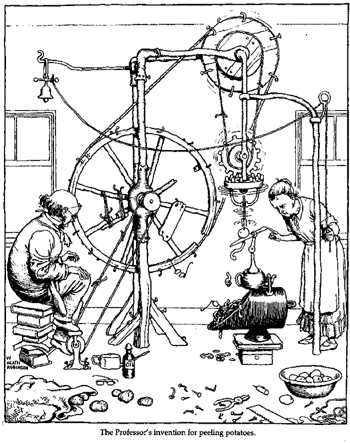
Final Destination 2. Another horrible guilty pleasure. Not only do the creators of the Final Destination films have sick senses of humour, they are obsessed with Rube-Goldberg systems. You know? Like one of these:

The crucial difference between this Rube-Goldberg and a Final Destination Rube-Goldberg lies primarily in the fact that in a Final Destination Rube-Goldberg, there is a head at the end about to get busted. Ugh. Oh, and instead of goofy scientists engineering the whole system, in this movie, it's "Death" trying to tie up his loose ends. Why does Death have to act through rickety Rube-Goldberg contraptions scene-by-scene instead of just simultaneously giving each survivor an aneurysm? Aneurysms are more suspicious, I guess. And besides, there would be four less campy horror films in the world to laugh at.

Last weekend, I subjected myself to (most of) Rob Zombie's attempts at a Halloween reboot. Both films are nasty, filthy, and generally unpleasant. Friday the 13th and Elm Street have taught me to laugh at slasher flicks and how campy they are, as have Scream, I Know What You Did Last Summer, etc. Neither of Rob Zombie's films were creepy, jumpy, funny, or ridiculous. Both were purely disgusting.

I also watched the 2009 remake of Friday the 13th, which I, on the other hand, actually kind of liked. My only qualm was that it seemed to be suggesting that Gen Yers are stupid enough to be outwitted by Jason Voorhees. Please. Gen Xers might be naive enough to fall under the blade of a serial killer who walks at a pace of 0.5 metres per second, but my generation certainly isn't.

"This one ate only tangerines for weeks."

So True Blood this week put my opinion of Tara back at square one. Initially, I was disappointed she didn't swallow the pills (but then again, it wasn't a huge surprise), but I was later on impressed with her sick fighting moves she pulled on those rednecks.

All in all, the girls were really on the offence in this episode--when asked if she can handle a revolver, Sookie says "I ain't that blond," and upon seeing a werewolf in the forest, she runs right after him yelling and calling him a coward.

When asked to leave the room, Pam mutters with bitter sarcasm, "Let's go to the ladies room and stare at ourselves in the mirror," asking Jessica to join her. For Jessica, this is an opportunity to find out how exactly one "stops drinking" a live human's blood, as well as how to dispose of a certain body that may or may not be stinking up Bill's house. The Jessica murder plot arc is interesting--while it's a source of comic relief, it also gives a lot of insight into the physiology of True Blood vamps, building on the revelation that vamps' makers can "call" them.

A few faces that popped up, some old, some new:

Denis O'Hare as Russell Edgington (who, pardon my ignorance, looks a little bit like Emperor Palpatine [Ian McDiarmid]).

Allan Hyde re-appears as Godric in a flashback relating to the new "Nazi-werewolf" villains.

Accomplished TV actress Alfre Woodard, as Lafayette's mother.

Marshall Allman as a relative of Sam's, Tommy Mickens.

Annnnd, of course, I will not deprive you of a couple more memorable quotations:

Sookie: "I keep expecting him [Bill] to come through the door and say... [in an imitation of Bill's voice] Sookeh..."

Andy [sarcastic]: "No, it's cuz of me winnin' the Miss America pageant!"

Thursday, June 17, 2010

It's 2010. Do you know where your politicians are?

Some two months ago, Dalton McGuinty, the premier of Ontario, was pressured by religious conservatives to back down on his proposed changes to the sex ed curriculum. Around the same time, the federal government refused to fund abortions as part of a global maternal health care initiative. In recent months, the federal government has also slashed the budgets of several feminist groups, including Status of Women Canada.

For Marci McDonald, these events would point to the invisible and alarming influence the Christian right holds over Canadian politics, as is made clear by her new book The Armageddon Factor. And although the book does not refer to these specific events, the cultural context McDonald is referring to ought to be resonant to Canadian readers.

As McDonald refers to her book as a “wake-up call” to the influence of the religious right in Canadian government, trigger-happy critics of the book may dismiss it as fear-mongering—and acceptably so. McDonald introduces readers to some of the sleaziest and most abrasive social conservatives, including Faytene Kryskow (a right-wing Christian activist), who claims to regularly hear the voice of God and encourages her followers to throw “prayer bombs” at Parliament in hopes that MPs consider adopting their pro-life and anti-gay politics. Others include a Baptist minister who prophesizes that the Canadian government has three years to reverse same-sex marriage legislation or be condemned to hell, as well as the founder of Crossroads Television, David Mainse, whose sons were involved in a Ponzi scheme south of the border. McDonald reveals a number of thread-thin links between these figures and several members of our current government. All in all, many of these cases may lead naive readers into making a guilty-by-association verdict about our current government. To be honest, the book certainly didn’t pique my interest in voting Conservative anytime soon.

To McDonald’s credit, however, the book carries a more important non-partisan message. By going straight to the sources of the Reform movement and Canadian social conservatism, The Armageddon Factor does for all voters what Food Inc does for health freaks. We are inclined to question where our politicians’ ideas and beliefs are coming from, and, in what I think is the most important question posed by this book, what is becoming of our country’s separation between church and state. Although McDonald devotes most of her focus to the religious right, she does give a page to the religious left--a movement she finds equally troubling for reasons I won’t elaborate on lest I spoil the book for you.

The other pearl of wisdom to take away from this read is that our federal government holds a lot more power than we’d like to think. Probably one of the most common assumptions made by disillusioned voters is that it doesn’t matter which way you vote—all parties effectively do the same thing. McDonald deftly quashes this mistaken belief through the case of the current party, uncovering funding cuts, donations, and court and senate appointments, most of which can be traced back to the demands of some of the nastiest religious conservatives. Agree or disagree with their politics—the point is, there are people speaking up whom most Canadians would consider to be distastefully radical.

Political agenda aside, The Armageddon Factor reminds us of the importance of a healthy political conscience in a time when our naiveté renders us pliable.


Sunday, June 13, 2010

"Can I use your shower?": True Blood Season 3 is back

At long last, True Blood is back. It's been a painful year, and we've waited for it the way a Twi-hard waits for marriage. And what a consummating experience the premiere was.

Sam is on a search for his parents in Arkansas (ugh), and has an encounter that makes for an unprecedented but rather pleasant scene.

Jessica has a bad smell problem and Jason has more sexual dysfunction. Meanwhile, Sophie-Anne (Evan Rachel Wood), the Vampire Queen of Louisiana, despite having indomitable sass and eviscerating wit, is terrible at lying.

Oh, and Eric has a bluetooth. Not that that's the only way vamps call each other, of course.

Aaaand, of course, what would a season of True Blood be without a murder?

Believe me--this season premiere does not disappoint.

A couple memorable quotations:

"How 'bout you just call us the Fuck-you Crew?"

Andy [to Jason]: Conscience off, dick on, and everything's gonna be all right!

Lafayette: "Bitch, You-Me bridge gonna never mother-fuckin-happen."


Saturday, June 12, 2010

The Ultimate Good!

Today, on my way to the library to pick up a book, I noticed that one of the stacks in the Mackinnon building normally set aside for The Peak held a copy of a magazine I had never seen before.

Curious, I picked it up.

Clearly, someone with a sense of humour had been and gone.

The magazine is The Undercurrent, and it provides "cultural commentary based on Ayn Rand's philosophy, Objectivism." I found in this particular issue articles with such titles as "Sacrifice Before Solvency: Business schools fail their students by emphasizing altruism rather than the virtues of wealth creation," "The Value of Atlas Shrugged" and "Why are we moving toward socialized medicine?"

Perhaps I will provide to The Undercurrent a few Ayn-Randian pieces of my own: "Why being a selfish prick is good," "Nestle takes India's water but at least it gives them jobs," and "Gay is OK, as long as I can still bash you."

Now, I think I will move this magazine to its appropriate place: the garbage.

Wednesday, June 9, 2010

Glee: A guilty pleasure ends its first season

Like a president’s scholar doing MDMA for the first time, Glee ran through the latter half of its first season without a clue as to where it was going. Loose ends were whipped recklessly around, characters were starved of motivation for their actions, but there was a whole lot of music and a whole lot of glitter.

Sadly, the show has started in recent episodes to be driven by its theme-of-the-week instead of any plausible conflict or character development. “Theatricality” seemed to frame an entire episode simply because the producers wanted a few Lady Gaga covers. While “Funk” was supposed to reveal Vocal Adrenaline’s jugular (because they’re “soulless automatons” and can’t understand funk), it never really played out into the plot, which essentially remained idle.

With the plot idle, the characters were left to lounge around and stew in their own stereotypical portraits.

Apparently bored with Kurt dropping fashion references, the writers decided they’d make a painfully ridiculous plot arc in which he thought he’d turn straight, date Brittany (ugh), and sing John Mellencamp.

Meanwhile, Artie had a dream in which he was magically abled, a scene that may or may not have been made with the purpose of showing viewers that Kevin McHale doesn’t actually need a wheelchair to get around.

Mercedes had what (I think) passed for serious body issues, to which Quinn could apparently relate because, you know, when you’re pregnant, the stigma doesn’t come from being pregnant, but from being fat!

I like to call Glee’s approach to casting and representation “diversity management.” The othered characters serve the purpose of either a) creating identitarian conflict or b) making New Directions look inclusive and attractive to as many different viewers as possible, all without having to give any of these othered characters any depth. Meanwhile, Rachel and Finn continue to hog the spotlight.

In the season finale, Olivia Newton John, playing herself, ironically refers to New Directions as “tokenistic.” Is this a sign the writers realize their show has representation issues, and intend to rectify the problem? I sincerely hope so.

How Sue sees it

The too-cruel-for-school gym teacher with the bureaucracy inexplicably on her side was, really, what hooked my interest in Glee initially. Interestingly enough, Sue Sylvester was the one aspect of the show that kept my faith alive throughout its dismal second half. And sure enough, she delivered.

I frequently found myself saying, “There isn’t nearly enough Sue in this episode!” What relatively little of her that was shown, however, really turned Sue Sylvester on her head. One might make the argument that it’s a little too much to show Sue Sylvester sulking in bed or at all expressing her true feelings, but, ultimately, the dulling of her ego amounted to one of the most crucial (if not the only) plot developments in the second half of the series.

By pairing the word “dull” with Sue Sylvester’s ego, I don’t at all mean to suggest her career as venomous queen of one-liners is nearing its end. She continues to deliver a decent share of hair-related insults and politically-incorrect zingers:

“You have enough product in your hair to season a wok.”

“I might buy a small diaper for your chin, because it looks like a baby’s ass.”

And, of course, my absolute favourite this half of the season:

“Your hair looks like a briar patch. I keep expecting racist, animated Disney characters to pop up and start singing about living on the bayou.”

Now that Glee has been renewed for another two seasons, a big and bright future looms. Here’s hoping our president’s scholar starts making more good life choices. Either way, the music will continue to be catchy, and Sue Sylvester will continue to be vile. I’m afraid to say those two things alone are enough to keep me watching.

Thank the devil for guilty pleasures.

"Scientists push boundaries," but does Splice do the same?

When St. Mary’s Cement wanted to start a quarry operation near my hometown of Flamborough, people were outraged. All that digging and blasting surely risked clouding our drinking water and turning the water table on its head.

But no, St. Mary's assured, that wouldn't happen. Their scientists had done studies that proved it wouldn't happen.

Of course, if there was some innocent truth hidden beneath the layers of Niagara limestone that whispers Don’t dig, don’t dig, St. Mary’s scientists were determined not to find it so the government would say, Dig, baby, dig! And so we should remain suspicious of the company scientists’ so-called findings.

Why this example in a review of a movie on gene-splicing, you ask?

What I took away as the “innocent truth” of Vincenzo Natali’s latest film was that the human factor is part of what makes science flawed. Scientists aren’t sages who unwaveringly hold the lantern up to the universal truth. No, they have emotional problems and nasty childhood experiences, they wear atrocious tweed suits with black cynical-slogan-bearing t-shirts underneath, they hang anime paintings above their beds, and they listen to bad electro music in the lab. Furthermore, they work for evil corporations.

Clive and Elsa are two such scientists. They’re servants of a pharmaceutical company that isn’t any more interested in the betterment of humankind than St. Mary’s was in protecting our drinking water. The quirky and hormone-driven couple conduct experiments in gene-splicing by combining the DNA of several different animals into one organism that will produce special proteins, which can in turn be synthesized and sold as drugs by the company for sizeable profits. Although proud of their initial creations (noisy grub-like creatures reminiscent of the Combine advisors of Half-life), Clive and Elsa want to go further by adding human DNA into the mix. When the company decides to end their splicing experiments, the scientists rebel and go ahead with their plans, creating Dren.

Much of the movie follows Dren’s rapid and grotesque development, which corresponds with the unwinding of Clive and Elsa’s relationship and the revelation of their individual problems. As the film progresses further, we become aware of the classic theme of humanity’s secret inhumanity. Meanwhile, Dren is relegated to the background (literally, a barn) where she skitters around murdering small animals and eerily spelling out three-syllable words with Scrabble letters. We expect her as an alternative to the couple’s madness, but instead she becomes a mirror for it. A film that starts off piquing our curiosity also plays on our anxiety around and contempt for animalistic brutality, which we fear could be part of our nature as well.

In nearly every interview about Splice, director Vincenzo Natali and Sarah Polley (Elsa) emphasize how this film poses questions about humanity’s ability to handle the answers science provides us. But for the audience, Dren is a predictable and generic monster animal. She comes when she’s called, preys on other animals, develops quirky fixations, and has tantrums when deprived of them. No surprises there, really. Instead of gripping the edge of your seat, you want to hit Clive and Elsa with one of their own textbooks.

Splice is an entertaining film--don't get me wrong--but it isn't nearly as provocative as it's "Meet Dren" marketing campaign makes it out to be. Would it have killed Natali to have Dren venture outside contemporary science’s expectations of animals? After all, people do things that biology can’t entirely explain, and Dren has human DNA.

But I’m not going to deny the film’s aesthetic power. The few twists are unremarkable, but Brody, Polley, and Hewlett all bring the same charm to their roles we can always depend on, and there are some visceral scenes sure to stick to you. Overall, Splice makes for a decent horror/sci-fi experience; it slinks, hisses, roars, and gnashes. It just doesn’t stir the pot.