Showing posts with label horror. Show all posts

Sunday, June 20, 2010

"Culture" I consumed this weekend, and last

Last night, I was a complete vegetable, having that day dragged my hung-over ass home from Toronto (without a singular drop of coffee) then to Niagara-on-the-Lake to see Alisa Palmer's take on Clare Boothe Luce's The Women, then back to some friends' place for too much good food.

So what did I do when I got home?

Like a true, certifiably organic vegetable, I vegged and watched a couple rot-worthy movies.

If Sweeney Todd didn't make you sick of

1. Johnny Depp;

2. Johnny Depp's British accent;

3. Johnny Depp speaking with a British accent in Victorian London;

4. Johnny Depp in a twisted gothic take on Victorian London involving gruesome murders;

or 5. demonic occult shit in Victorian London, then maybe the 2001 film From Hell is worth checking out. In spite of the gory imagery, it's a particular pair of dilated pupils that will chill you to the bone in this film. It's based on the graphic novel by Alan Moore (who has written almost every graphic novel) and Eddie Campbell.

She's the Man is a dark, dirty, guilty pleasure for me. Okay, I know it's an absolutely terrible movie and should just accept it for what it is, but why why why is Channing Tatum's character named Duke? Who names their kid Duke? I can't get over it. Duke is a name one might more aptly give to a dog. Anyway, I really like this movie and am under no obligation to defend it using reason.

Final Destination 2. Another horrible guilty pleasure. Not only do the creators of the Final Destination films have sick senses of humour, they are obsessed with Rube-Goldberg systems. You know? Like one of these:
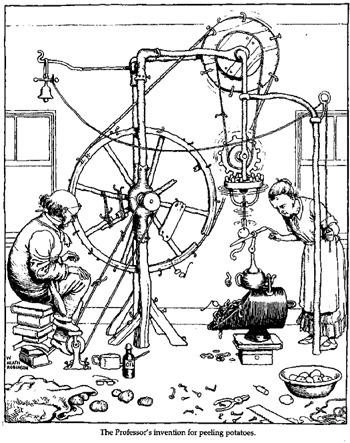
The crucial difference between this Rube-Goldberg and a Final Destination Rube-Goldberg lies primarily in the fact that in a Final Destination Rube-Goldberg, there is a head at the end about to get busted. Ugh. Oh, and instead of goofy scientists engineering the whole system, in this movie, it's "Death" trying to tie up his loose ends. Why does Death have to act through rickety Rube-Goldberg contraptions scene-by-scene instead of just simultaneously giving each survivor an aneurysm? Aneurysms are more suspicious, I guess. And besides, there would be four less campy horror films in the world to laugh at.

Last weekend, I subjected myself to (most of) Rob Zombie's attempts at a Halloween reboot. Both films are nasty, filthy, and generally unpleasant. Friday the 13th and Elm Street have taught me to laugh at slasher flicks and how campy they are, as have Scream, I Know What You Did Last Summer, etc. Neither of Rob Zombie's films were creepy, jumpy, funny, or ridiculous. Both were purely disgusting.

I also watched the 2009 remake of Friday the 13th, which I, on the other hand, actually kind of liked. My only qualm was that it seemed to be suggesting that Gen Yers are stupid enough to be outwitted by Jason Voorhees. Please. Gen Xers might be naive enough to fall under the blade of a serial killer who walks at a pace of 0.5 metres per second, but my generation certainly isn't.

Wednesday, June 9, 2010

"Scientists push boundaries," but does Splice do the same?

When St. Mary’s Cement wanted to start a quarry operation near my hometown of Flamborough, people were outraged. All that digging and blasting surely risked clouding our drinking water and turning the water table on its head.

But no, St. Mary's assured, that wouldn't happen. Their scientists had done studies that proved it wouldn't happen.

Of course, if there was some innocent truth hidden beneath the layers of Niagara limestone that whispers Don’t dig, don’t dig, St. Mary’s scientists were determined not to find it so the government would say, Dig, baby, dig! And so we should remain suspicious of the company scientists’ so-called findings.

Why this example in a review of a movie on gene-splicing, you ask?

What I took away as the “innocent truth” of Vincenzo Natali’s latest film was that the human factor is part of what makes science flawed. Scientists aren’t sages who unwaveringly hold the lantern up to the universal truth. No, they have emotional problems and nasty childhood experiences, they wear atrocious tweed suits with black cynical-slogan-bearing t-shirts underneath, they hang anime paintings above their beds, and they listen to bad electro music in the lab. Furthermore, they work for evil corporations.

Clive and Elsa are two such scientists. They’re servants of a pharmaceutical company that isn’t any more interested in the betterment of humankind than St. Mary’s was in protecting our drinking water. The quirky and hormone-driven couple conduct experiments in gene-splicing by combining the DNA of several different animals into one organism that will produce special proteins, which can in turn be synthesized and sold as drugs by the company for sizeable profits. Although proud of their initial creations (noisy grub-like creatures reminiscent of the Combine advisors of Half-life), Clive and Elsa want to go further by adding human DNA into the mix. When the company decides to end their splicing experiments, the scientists rebel and go ahead with their plans, creating Dren.

Much of the movie follows Dren’s rapid and grotesque development, which corresponds with the unwinding of Clive and Elsa’s relationship and the revelation of their individual problems. As the film progresses further, we become aware of the classic theme of humanity’s secret inhumanity. Meanwhile, Dren is relegated to the background (literally, a barn) where she skitters around murdering small animals and eerily spelling out three-syllable words with Scrabble letters. We expect her as an alternative to the couple’s madness, but instead she becomes a mirror for it. A film that starts off piquing our curiosity also plays on our anxiety around and contempt for animalistic brutality, which we fear could be part of our nature as well.

In nearly every interview about Splice, director Vincenzo Natali and Sarah Polley (Elsa) emphasize how this film poses questions about humanity’s ability to handle the answers science provides us. But for the audience, Dren is a predictable and generic monster animal. She comes when she’s called, preys on other animals, develops quirky fixations, and has tantrums when deprived of them. No surprises there, really. Instead of gripping the edge of your seat, you want to hit Clive and Elsa with one of their own textbooks.

Splice is an entertaining film--don't get me wrong--but it isn't nearly as provocative as it's "Meet Dren" marketing campaign makes it out to be. Would it have killed Natali to have Dren venture outside contemporary science’s expectations of animals? After all, people do things that biology can’t entirely explain, and Dren has human DNA.

But I’m not going to deny the film’s aesthetic power. The few twists are unremarkable, but Brody, Polley, and Hewlett all bring the same charm to their roles we can always depend on, and there are some visceral scenes sure to stick to you. Overall, Splice makes for a decent horror/sci-fi experience; it slinks, hisses, roars, and gnashes. It just doesn’t stir the pot.